Every JEE Main aspirant has heard this advice:
“Solve PYQs.”
The advice is correct, but many students don’t know when or how to solve them.
The best time to start is after completing a chapter. Solve its previous year questions (PYQ) to check your understanding and get familiar with the type of questions asked in JEE Main.
That’s where a smart PYQ strategy makes a real difference.
Some students solve hundreds of questions but don’t see much improvement. Others solve fewer PYQs and still score well.
The difference is not the number of questions. The difference is how you practice them.
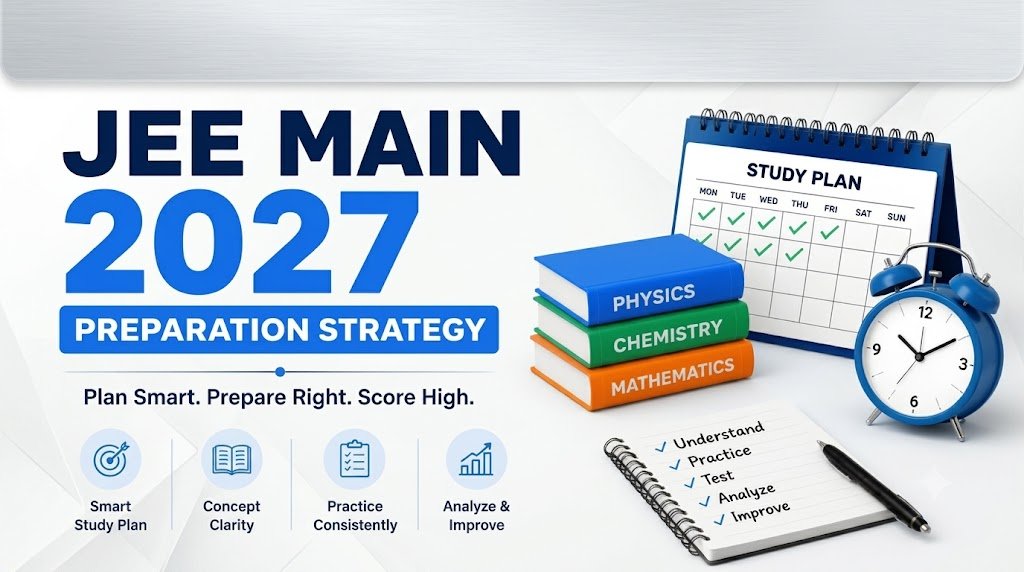
If you’re preparing for JEE Main 2027, this guide will show you a simple PYQ strategy that can help you improve your concepts, accuracy, and confidence.
Why Should You Solve PYQs?
Many teachers and JEE toppers recommend PYQs for one simple reason. They help you prepare in the right direction.
Regular PYQ practice can help you:
- Understand the exam
- Learn which topics are asked again and
- Improve speed and
- Find weak
- Build confidence before the
PYQs are not just another question bank. They help you prepare for the real JEE Main exam.
When Should You Start Solving PYQs?
Don’t wait until the last few months.
The best time to start is after completing each chapter.
For example, if you finish Electrostatics, revise it first and then solve its PYQs. Follow the same process for every chapter.

This makes revision easier and helps you remember concepts for a longer time.
Follow This Simple PYQ Strategy
Don’t solve PYQs randomly. Follow this order every time:
Complete the Chapter → Revise Notes & Formulas → Solve Chapter-wise PYQs → Analyze Mistakes → Revise Weak Topics → Start the Next Chapter
This simple routine keeps your preparation organized.
Step 1: Finish the Chapter First
Don’t solve PYQs after reading a chapter only once. First:
- Complete the
- Understand the
- Revise your
- Learn the important
Then start solving PYQs.
This will make the questions much easier to understand.
Step 2: Solve Chapter-wise PYQs
Practice questions from only one chapter at a time. For example:
- Complete Work, Power and
- Revise your
- Solve its
- Check your
- Revise weak
- Move to the next
This method helps you improve one chapter before starting another.
Step 3: Don’t Check the Answer Too Quickly
Got stuck on a question?
Don’t open the solution immediately. Spend a few minutes thinking.
Try another method.

Even if you cannot solve it, you will understand the solution much better after trying. That’s how real learning happens.
Step 4: Learn from Every Mistake
Most students only check their score. That’s not enough.
After every PYQ session, ask yourself:
- Did I forget the concept?
- Did I use the wrong formula?
- Was it a calculation mistake?
- Did I read the question too quickly?
Finding the reason behind a mistake is more important than counting correct answers.
Step 5: Keep a Mistake Notebook
This is one of the easiest ways to improve. Write down:
- Questions you couldn’t
- Important
- New
- Common calculation
Read this notebook every week.
It will save you a lot of revision time later.
Step 6: Solve Important Questions Again
Don’t solve a PYQ only once.
After a few weeks, solve the difficult questions again.
If you can solve them without looking at the solution, your preparation is improving. If not, revise that topic once more.
Step 7: Start Full-Length PYQ Papers
After finishing most of your syllabus, start solving complete JEE Main previous year papers. Treat every paper like the real exam.

- Finish it in 3
- Don’t pause the
- Don’t check answers in
- Analyze the paper after
This improves your speed, confidence, and time management.
Use PYQs and Mock Tests Together
PYQs and mock tests have different purposes.
PYQs help you understand the type of questions asked in JEE Main and test how well you know a chapter.
After solving the PYQs, attempt a chapter-wise mock test to see how you perform under exam-like conditions.
Mock tests improve your speed, accuracy, time management, and confidence.
Once you complete most of the syllabus, start solving full-length mock tests and previous year papers regularly.
FAQs
Q: How many years of JEE Main PYQs should I solve for 2027?
A: Solve at least the last 5–7 years of JEE Main PYQs. They follow the latest exam pattern and help you understand the concepts and question types that are asked frequently.
Q: Should I solve chapter-wise PYQs or full-length papers first?
A: Start with chapter-wise PYQs after completing each chapter. Once you’ve covered most of the syllabus, begin solving full-length previous year papers under exam-like conditions.
Q: Are JEE Main PYQs enough for 2027 preparation?
A: No. PYQs are an important part of preparation, but you should also revise your concepts, practice questions regularly, and take mock tests to improve speed and accuracy.
Q: When should I start solving full-length JEE Main previous year papers?
A: Start solving full-length previous year papers after completing 70–80% of your syllabus. This will help you practice time management and prepare for the actual exam.